How much does a retaining wall cost in New Jersey?
A retaining wall costs $35 to $65 per square foot of wall face on average, installed, according to HomeGuide (January 16, 2026), so a 50-foot wall 4 feet tall runs about $7,000 to $13,000. New Jersey contractors publish overlapping figures: $35 to $65 per square foot of face for segmental block in South Jersey (Patrick Breen, February 2026) and $30 to $75 in Sussex County (JWSR, August 2026). A wall with a total height of four feet or more, measured from the bottom of the footing, also needs a construction permit and an engineered design in New Jersey, which adds to the cost.
How much is a 4 ft retaining wall?
Nationally, HomeGuide puts a 4-foot wall at $1,400 to $2,600 for 10 feet of length and $7,000 to $13,000 for 50 feet, and Fixr's average (January 2025) is $5,463 for a concrete block wall 25 feet long and 4 feet high. In New Jersey, 4 feet is where the rules change: a wall with a total height of four feet or greater, measured from the bottom of the footing to the top of the wall, needs a construction permit and an engineered design. Engineering runs $350 to $750 by Angi's figures and $500 to $2,000 or more by HomeGuide's.
How much does a 100 ft retaining wall cost?
HomeGuide puts 100 feet of wall at $7,000 to $13,000 at 2 feet tall, $14,000 to $26,000 at 4 feet and $21,000 to $39,000 at 6 feet. Angi's range for 100 feet is $4,000 to $36,000, with an average of $20,000. At AB Contracting & Design's published $40 per Cambridge Sigma 8 block, a 100-foot wall showing 4 feet with one course buried is about 467 blocks, about $18,670 for the block line alone, before drainage, geogrid, caps, engineering and the permit.
How much does a 30-foot retaining wall cost?
Angi puts 30 feet of wall at $1,200 to $10,800 (September 15, 2026). At AB Contracting & Design's published $40 per Cambridge Sigma 8 block, 30 feet showing 2 feet 8 inches with one course buried is 100 blocks, $4,000 for the block line. Showing 3 feet 4 inches it is 120 blocks, $4,800, and that wall is already 4 feet of block, which in New Jersey means a construction permit and an engineered design. Drainage, geogrid, caps, engineering and the permit are priced on top.
How do you calculate the cost of a retaining wall?
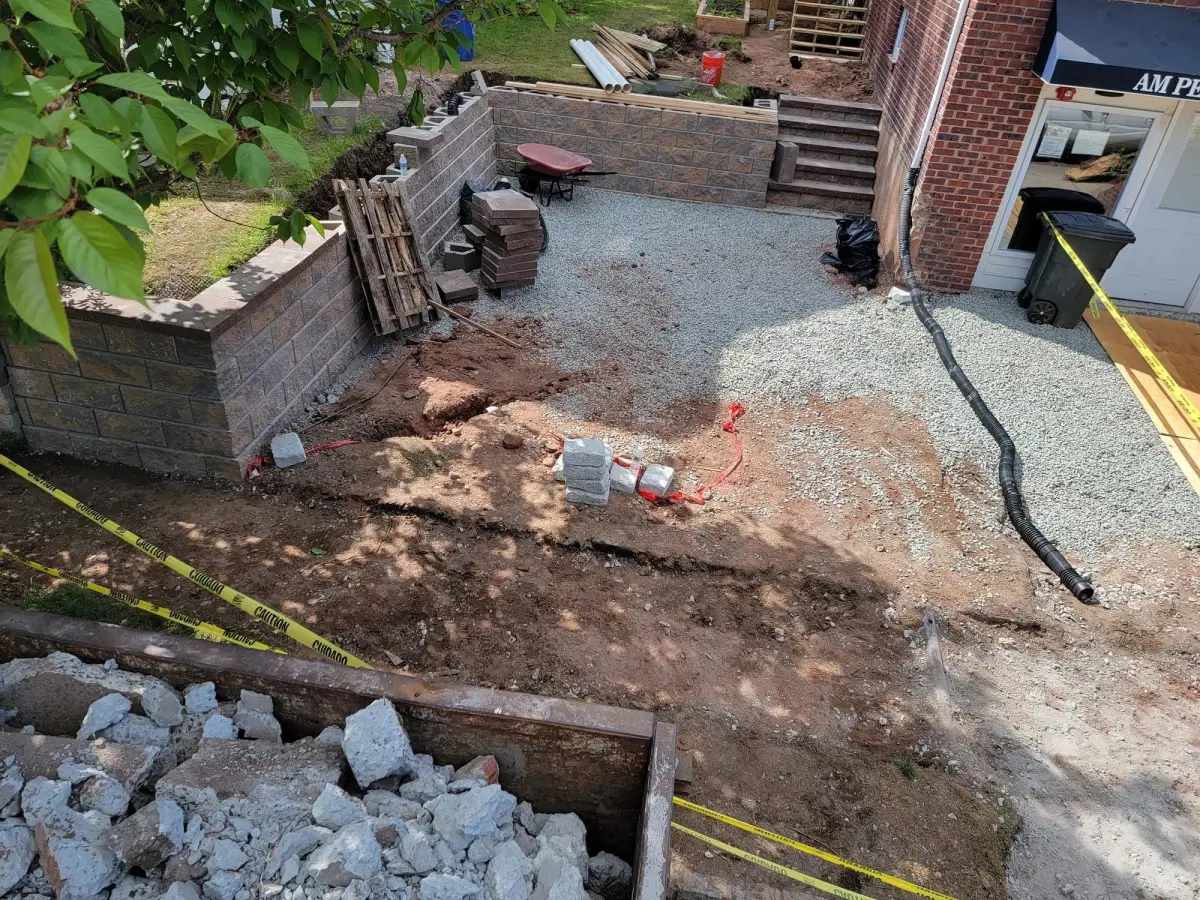
Multiply the face area, length times height, by an installed price per square foot, then add the items priced separately: drainage, geogrid, caps, removal of an old wall, engineering and the permit. With Cambridge Sigma 8 block it is simpler to count blocks: each block covers one square foot of face, and at least one course is normally buried below grade. AB Contracting & Design publishes $40 per Sigma 8 block with the block included, so the block count times $40 gives the block line of a proposal.
Do I need a permit for a retaining wall in New Jersey?
Yes, if the wall or series of walls has a total height of four feet or greater, or if a wall under four feet has a negative impact on a foundation (N.J.A.C. 5:23-2.14(g)). Height is measured from the bottom of the footing to the top of the wall, and all retaining walls on the same slope are added together. The rule also covers enlarging, rebuilding or demolishing such a wall. Your town may add its own zoning limits, so ask the construction office before you design the wall.
Can I build two shorter walls instead of one tall wall to avoid the permit?
Not in New Jersey. The construction code adds together the heights of all retaining walls on the same slope, so two 3-foot walls on one slope count as a 6-foot wall. Some towns go further: Montclair treats terraced walls as one wall unless the upper wall sits at least four feet back from the face of the lower one.
What is the 1/3 rule for retaining walls?
It is a rule of thumb, not a code requirement, and sources define it in different ways: that a third of the wall should be buried, that the footing or base should be sized at about a third of the wall's height, or that the soil's push should act within the middle third of the base. Nicolock, a block maker, says neither common version governs segmental block walls, which are built to the manufacturer's tables. Cambridge's Sigma 8 Pro Guide calls for at least 6 inches buried, typically one full block, on a compacted leveling pad at least 6 inches deep, and New Jersey requires an engineered design once a wall needs a permit.
What is the cheapest type of retaining wall?
Sources disagree. Vinyl and timber are the lowest per square foot in HomeGuide's January 2026 table, at $10 to $20 and $15 to $30, while Forbes calls poured concrete one of the cheapest for how long it lasts. In New Jersey, height can matter as much as material: a wall under four feet in total, counting the footing and every wall on the same slope, with no negative impact on a foundation, stays below the State permit trigger and the engineered design that comes with it. Some towns still require a permit, so check with yours.
How much does it cost to repair a retaining wall?
Angi puts retaining wall repairs at $450 to $950, about $700 on average (July 9, 2026), with bowing or leaning walls at $275 to $1,200. Removing and rebuilding a wall runs $6,000 to $14,000 by HomeGuide's figures. Angi names soil that was not compacted during construction as the most common cause of leaning, along with poor drainage. In New Jersey, repair labor is subject to sales tax, and rebuilding a wall of four feet or more needs a permit.
Do I have to call 811 before building a retaining wall in New Jersey?
Yes. New Jersey's One-Call rules treat a homeowner who digs as an excavator, with the same duty to call. Notice goes to the One-Call system at least three and no more than ten business days before digging, by dialing 811. The notice stays valid for 45 business days as long as the marks are kept up, you must hand dig within two feet of a marked line, and penalties run $1,000 to $2,500 a day.
How do I get a price from AB Contracting & Design?
Call AB at 908-331-0796 and ask for Andrew, or send the wall with the form on this page and LA Trusted passes it to AB. Phone estimates are free; an in-person estimate is $50 and comes off the contract when you sign. Count the blocks in the wall face first and you will have a close number for the block line before the visit.